|
|
|
X-RATOS II HTV
As an enhancement of the X-RATOS project, a "Health Monitoring-Telemetry/Telecommand-Video Data Processing-System" (HTV) was developed within the frame of additional studies. HTV is a measuring data recording and transmission system with the capability to control operational parameters in parallel. The main focus lies on the characteristics of motion of X-RATOS II, which is analysed by means of various measuring methods using different sensor technologies.
|
|
|
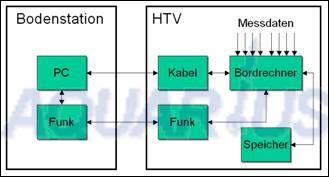
Fig. 6: Telemetry/Telecommand function diagram and technical specifications of HTV
Tank pressure and temperature as well as velocity and acceleration of the vehicle are measured simultaneously while additional image data is recorded and transmitted via video camera. All measuring data are recorded versus time in order to draw conclusions from the operation behaviour of X-RATOS II and to optimize its performance. The system is integrated in an individually designed model of a reusable horizontal take-off and landing (HTOL) launch vehicle.
|
|
|
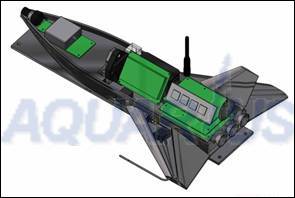
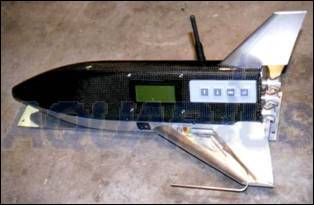
Fig. 7:
RLV model with integrated measuring data recording and transmission system (HTV)
for AQUARIUS X-RATOS II: CAD design (left) and the actual hardware type (right)
The measuring system includes sensors to convert the measured values into analogue voltages being then digitalised by a microcontroller. Throughout the pre-start phase, all received sensor data can be displayed after further processing on a LCD, which is integrated in the launch vehicle model. During operation of the take-off assistance system, part of this data as well as the video data is transmitted via radio communication to a PC and can be analysed in real time. Furthermore all data are recorded within the HTV thus enabling a post-processing via a standard serial interface.